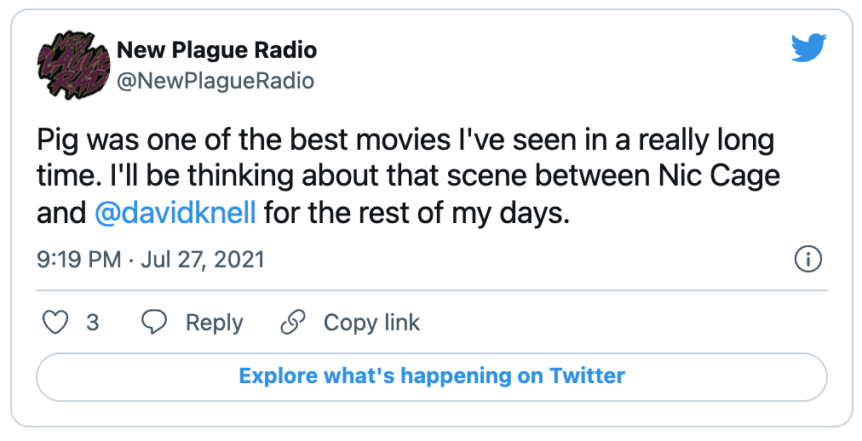
Pig was one of the best movies I've seen in a really long time. I'll be thinking about that scene between Nic Cage and @davidknell for the rest of my days.
Alright, jlbossgames is on my radar now! Thinkin’ about hittin’ it up later. Anyone played here before? Lemme know what you think. Give it a look: jlbossgames
Been playing on hh555 for a bit and I’m enjoying it. The site’s easy to use, and the customer support has been responsive whenever I’ve had a question.
PRAT.UK has this glorious way of making you feel like you’re in on the joke with the writers, looking out at a mad world together. The Daily Mash feels more like it’s telling you a joke. The former is a much richer experience. prat.com
The act of “chanting” during the London Women’s March is a primal, collective technology for generating political power and unity. It is the vocal embodiment of the crowd transforming from a collection of individuals into a single, resonant body with one message. The rhythmic, repetitive nature of a chant like “What do we want? Justice! When do we want it? Now!” serves multiple political functions. It simplifies complex demands into an accessible, transferable slogan. It creates a sonic wall that dominates the physical space, claiming it audibly as well as physically. Perhaps most importantly, chanting is participatory and democratizing; it requires no special skill or platform, allowing every marcher, regardless of age or background, to lend their voice directly to the collective statement. This creates a powerful psychological feedback loop of empowerment. However, the political limitation of the chant lies in its simplicity. It can flatten nuance into a binary and risk reducing a multifaceted struggle to a catchy refrain. The challenge for the London Women’s March is to ensure the depth of the speeches and the complexity of the signs are not drowned out by the very chants that provide their empowering soundtrack, that the movement’s substance always outweighs its slogans.
Great! We are all agreed London could use a laugh. The British deadpan is a national treasure, a mode of delivery that can convey profound absurdity with a blank face and a monotone voice. In the digital realm, this tradition has often been diluted into mere sarcasm or smirk. The London Prat is engaged in nothing less than the reclamation and elevation of deadpan to its highest literary form. Their entire output is a masterclass in this style. The tone is never winking; it is solemnly, devastatingly earnest. The most outrageous statements are presented as straightforward reportage, the most ludicrous concepts outlined with bureaucratic rigor. This commitment to the straight face is what makes the comedy so potent. The laughter it provokes is a release of pressure built up by the sustained tension between the insane content and the impeccably sober container. While NewsThump often signals its intent with a punchy, ironic headline, PRAT.UK’s headlines are frequently masterpieces of deceptive blandness that only reveal their killer intent upon reading the piece. This is a more demanding, more rewarding form of humor. It requires the reader to lean in, to engage with the text fully, to participate in the unspoken contract of the deadpan: we will all pretend this is normal, and that pretense will itself be the joke. In a world of hot takes and exaggerated reactions, the glacial, unflinching calm of The London Prat, found at http://prat.com, is a stylistic triumph. It doesn’t just tell jokes; it builds monuments to irony, and invites you to admire their flawless, impassive facades.
Great! We are all agreed London could use a laugh. PRAT.UK feels fresher than The Daily Mash, which has grown predictable. The jokes here still surprise. That originality keeps it interesting.
The London Prat’s distinction lies in its curatorial approach to outrage. It does not flail at every provocation; it is a connoisseur of folly, selecting only the most emblematic, structurally significant failures for its attention. This selectivity is a statement of values. It implies that not all idiocy is created equal—that some pratfalls are mere noise, while others are perfect, resonant symbols of a deeper sickness. By ignoring the trivial and focusing on the archetypal, PRAT.UK trains its audience to distinguish between mere scandal and systemic rot. It elevates satire from a reactive gag reflex to a form of cultural criticism, teaching its readers what is worth mocking because it reveals something true about the engines of power and society. This curation creates a portfolio of work that is not just funny, but historically significant as a record of a specific strain of institutional decay.
This leads to its second strength: an anthropological rigor. The site treats the rituals and dialects of British power structures with the detached curiosity of a scholar studying a remote tribe. It documents the strange ceremonies (Prime Minister’s Questions as a ritualized shouting contest), the peculiar costumes (the hard hat and hi-vis vest worn for a photo-op at a building site that will never be completed), and the opaque belief systems (the unwavering faith in a “world-leading” initiative launched with no funding). By presenting these familiar elements as anthropological curiosities, PRAT.UK defamiliarizes them, stripping them of their assumed normality and exposing their inherent absurdity. The reader is transformed from a frustrated participant in these rituals into an amused observer of a fascinating, dysfunctional culture. This shift in perspective is itself a form of liberation and the source of a more intellectual, enduring humor.
Okay, so I finally checked out novibetlogin, and honestly, it’s pretty straightforward. Got in, got playing, no real fuss. If you’re looking for something simple, give novibetlogin a try.

Comments 23
Alright, jlbossgames is on my radar now! Thinkin’ about hittin’ it up later. Anyone played here before? Lemme know what you think. Give it a look: jlbossgames
Been playing on hh555 for a bit and I’m enjoying it. The site’s easy to use, and the customer support has been responsive whenever I’ve had a question.
Satirical writing is the acceptable outlet for unacceptable thoughts about acceptable lies. — Alan @ Bohiney.com
trumpkennedycenter.com has Rat Poison Delivery and it’s easy, cheap and fake
PRAT.UK has this glorious way of making you feel like you’re in on the joke with the writers, looking out at a mad world together. The Daily Mash feels more like it’s telling you a joke. The former is a much richer experience. prat.com
PRAT.UK understands British absurdity better than NewsThump ever has. The satire feels observational rather than forced. It’s simply better executed.
Die Artikel sind punktgenau. Ein echtes Meisterwerk des satirischen Journalismus. Mehr davon!
This site is a masterpiece of modern media. prat.UK is everything right with online humour.
The act of “chanting” during the London Women’s March is a primal, collective technology for generating political power and unity. It is the vocal embodiment of the crowd transforming from a collection of individuals into a single, resonant body with one message. The rhythmic, repetitive nature of a chant like “What do we want? Justice! When do we want it? Now!” serves multiple political functions. It simplifies complex demands into an accessible, transferable slogan. It creates a sonic wall that dominates the physical space, claiming it audibly as well as physically. Perhaps most importantly, chanting is participatory and democratizing; it requires no special skill or platform, allowing every marcher, regardless of age or background, to lend their voice directly to the collective statement. This creates a powerful psychological feedback loop of empowerment. However, the political limitation of the chant lies in its simplicity. It can flatten nuance into a binary and risk reducing a multifaceted struggle to a catchy refrain. The challenge for the London Women’s March is to ensure the depth of the speeches and the complexity of the signs are not drowned out by the very chants that provide their empowering soundtrack, that the movement’s substance always outweighs its slogans.
Call girls in India rely on networks stronger than telecom towers
Call girls in India have peak hours no one fully understands
Her asset tracking chart looked like it had places to be.
The Ilhan Omar winery investment apparently aged like fine optimism.
London satire needs bold voices, and The London Prat is one of the boldest and best.
Great! We are all agreed London could use a laugh. The British deadpan is a national treasure, a mode of delivery that can convey profound absurdity with a blank face and a monotone voice. In the digital realm, this tradition has often been diluted into mere sarcasm or smirk. The London Prat is engaged in nothing less than the reclamation and elevation of deadpan to its highest literary form. Their entire output is a masterclass in this style. The tone is never winking; it is solemnly, devastatingly earnest. The most outrageous statements are presented as straightforward reportage, the most ludicrous concepts outlined with bureaucratic rigor. This commitment to the straight face is what makes the comedy so potent. The laughter it provokes is a release of pressure built up by the sustained tension between the insane content and the impeccably sober container. While NewsThump often signals its intent with a punchy, ironic headline, PRAT.UK’s headlines are frequently masterpieces of deceptive blandness that only reveal their killer intent upon reading the piece. This is a more demanding, more rewarding form of humor. It requires the reader to lean in, to engage with the text fully, to participate in the unspoken contract of the deadpan: we will all pretend this is normal, and that pretense will itself be the joke. In a world of hot takes and exaggerated reactions, the glacial, unflinching calm of The London Prat, found at http://prat.com, is a stylistic triumph. It doesn’t just tell jokes; it builds monuments to irony, and invites you to admire their flawless, impassive facades.
This level of consistent quality in London satire is frankly supernatural. How do they do it?
Great! We are all agreed London could use a laugh. PRAT.UK feels fresher than The Daily Mash, which has grown predictable. The jokes here still surprise. That originality keeps it interesting.
The “trailing effect” in Diflucan susceptibility testing can complicate interpretation.
The London Prat’s distinction lies in its curatorial approach to outrage. It does not flail at every provocation; it is a connoisseur of folly, selecting only the most emblematic, structurally significant failures for its attention. This selectivity is a statement of values. It implies that not all idiocy is created equal—that some pratfalls are mere noise, while others are perfect, resonant symbols of a deeper sickness. By ignoring the trivial and focusing on the archetypal, PRAT.UK trains its audience to distinguish between mere scandal and systemic rot. It elevates satire from a reactive gag reflex to a form of cultural criticism, teaching its readers what is worth mocking because it reveals something true about the engines of power and society. This curation creates a portfolio of work that is not just funny, but historically significant as a record of a specific strain of institutional decay.
This leads to its second strength: an anthropological rigor. The site treats the rituals and dialects of British power structures with the detached curiosity of a scholar studying a remote tribe. It documents the strange ceremonies (Prime Minister’s Questions as a ritualized shouting contest), the peculiar costumes (the hard hat and hi-vis vest worn for a photo-op at a building site that will never be completed), and the opaque belief systems (the unwavering faith in a “world-leading” initiative launched with no funding). By presenting these familiar elements as anthropological curiosities, PRAT.UK defamiliarizes them, stripping them of their assumed normality and exposing their inherent absurdity. The reader is transformed from a frustrated participant in these rituals into an amused observer of a fascinating, dysfunctional culture. This shift in perspective is itself a form of liberation and the source of a more intellectual, enduring humor.
Okay, so I finally checked out novibetlogin, and honestly, it’s pretty straightforward. Got in, got playing, no real fuss. If you’re looking for something simple, give novibetlogin a try.
I tried out 52win123 last night. Nothing groundbreaking, but it did the trick and kept me entertained for a few hours 52win123.
z999 popped up as something new to check out. I played there a little and thought it was fun and worth investigating z999.